Recently, I attended a remembrance service for my 15-year-old niece who died by suicide most unexpectedly. During the service, an attendee shared her tale of woe of her abusive upbringing and later her sudden divorce with the grieving father as an apparent attempt to offer some measure of compassion indicating she understood his emotional pain. She was, quite clumsily, attempting to relate with him, though in so doing failed to offer real compassion or empathy for his great loss.
I was reminded of the pitfalls of trying to relate to someone by sharing our own tales of woe when someone is grieving or hurting or is otherwise in need of compassion and empathy when this happens. Trying to relate to someone else’s pain often leaves the hurting person feeling as though their pain is invalidated and as though they must offer comfort when they, in fact, are the one in need of comforting.
When we try to relate rather than offering compassion and empathy for another person’s pain, often what happens is we are engaging in one-downing. What we are saying is, “I am uncomfortable with your pain, so let me tell you how bad I’ve had it.” When we are trying to relate to someone else’s pain by sharing our own tale of woe, what we are saying is that their pain is not as bad as our pain. We are not just invalidating their pain, we are invalidating their whole experience as insignificant compared to our own pain and our experience.
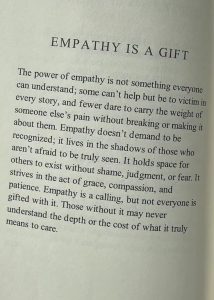
Compassion and empathy often go hand-in-hand, particularly when someone is grieving a loss. Real compassion and empathy ask us to hold without judgement another person’s feelings and experience, regardless of how those feelings or experiences may differ from our own. Compassion and empathy ask us to sit with another person’s feelings and experiences as that person feels and experiences an event or incident or experience. Real compassion and empathy do not ask us to compare our feelings or experience with another person. They ask us to simply accept another person’s experience and their feelings about that experience without judgement.
When we are trying to relate to someone’s feelings or experience and one-down with them instead, what we are saying is that our experience, our feelings are more important than the other person’s. That is neither caring nor compassionate. That is not offering someone empathy for what they have endured.
Offering real compassion and empathy asks us to be curious and open-minded about another person’s feelings and experience. That can sound like, “That must have been hard for you,” or even “I don’t know what to say, can I just sit with you right now?” Maybe that means we ask if that person needs a hand to hold or a hug or a shoulder to lean on. Sometimes that means we sit in silence with the hurting person and give them space to feel whatever it is they are feeling.
Compassion and empathy ask us to hold space for another person’s feelings and experience, without comparing those feelings or that experience to any of our own. We do this with kindness and openness. We do this with love and understanding. We do this softly and gently. We do not share our own tales of woe. We do not offer advice if it has not been asked for. We do not one-down with someone who is hurting. We accept their feelings and experiences as they want or need to share them.
Compassion and empathy are skills that not everyone possesses but that everyone can practice by not trying to relate to another person’s feelings or experience. We do not say, “I know exactly how you feel.” We do not say, “I can relate to that.” Everyone’s feelings and experiences are different and we as fellow humans would do well to remember that those feelings and experiences are just as valid as our own and need to be honored.
~ Karri Christiansen, MSW, LCSW, CADC, CCTP